
Six months into a major transformation, the executive team was asking the same question:
“Why aren’t we seeing results?”
The strategy was clear. The roadmap had executive buy-in. The metrics were defined.
On paper, everything was aligned. But inside the organization…Something wasn’t working. Frontline staff were disengaged. Middle managers were inconsistent in execution. And outcomes? Flat. No one could explain the gap.
The Failure No One Sees
This wasn’t a strategy failure.
It was a translation failure.
What leadership intended…Was not what operations executed.
And the most dangerous part? No one noticed early enough to correct it.
What Most Organizations Get Wrong
When transformation efforts stall, the default assumptions are predictable:
- “We need to communicate more.”
- “People are resisting change.”
- “We need stronger accountability.”
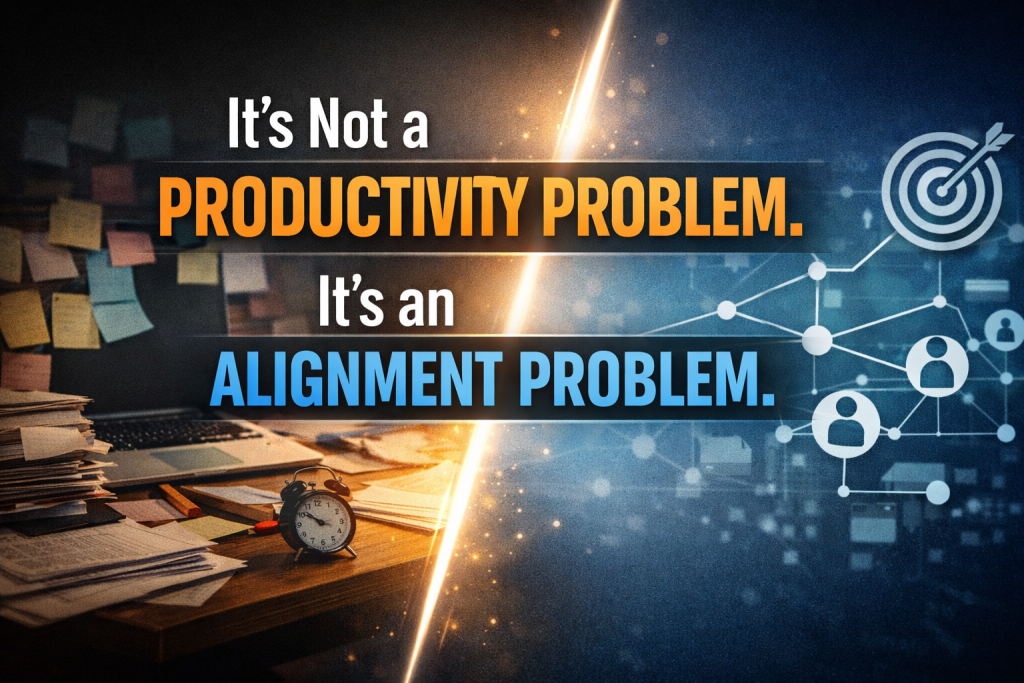
These responses sound reasonable—but they miss the real issue. Because the problem isn’t communication. And it’s not resistance.
The problem is misalignment between decision-making layers.
Where Transformation Actually Breaks
In every organization, transformation flows through three critical layers:
- Executive Leadership – sets strategy and direction
- Middle Management – interprets and operationalizes that strategy
- Frontline Teams – execute the work
Most organizations focus heavily on the top and the bottom. But transformation doesn’t succeed or fail there.
👉 It succeeds or fails in the middle layer.
Because that’s where strategy is translated into action. And when that translation is inconsistent, unclear, or misaligned—execution breaks down quietly.
The Cost of Misalignment
This gap is rarely visible in dashboards. But its impact shows up everywhere:
- Strategic initiatives that stall without clear explanation
- Frontline teams creating workarounds to “make things work”
- Leaders believing change is happening—when it isn’t
Over time, this leads to:
- Millions in wasted investment
- Burnout across teams
- Loss of trust in leadership initiatives
Not because the strategy was wrong— but because it never fully reached execution.
Why Communication Isn’t the Fix
Most organizations respond by increasing communication:
More meetings.
More emails.
More updates.
But communication does not guarantee alignment. You can clearly communicate a strategy…
and still have five different versions of it being executed. Because communication pushes information.
Alignment validates understanding.
What Actually Works
Organizations that consistently execute transformation do one thing differently: They don’t just cascade strategy.
They test and validate it across every level of the organization.
This is where structured alignment methods—like the catchball approach—become critical.
Instead of pushing decisions downward, they:
- Share strategic intent
- Require interpretation at each level
- Send that interpretation back for validation
- Adjust before execution begins
This creates a continuous loop of alignment—not a one-time communication event.
The Shift Leaders Need to Make
If you’re leading transformation, the question is no longer:
“Did we communicate the strategy?”
It’s:
👉 “How is this being interpreted and executed at each level?”
Because if you can’t answer that clearly—
you don’t have alignment.
And without alignment, execution will always drift.
A Simple Place to Start
If you’re not sure where your transformation may be breaking down, start here:
- Where are decisions being reinterpreted?
- Where are inconsistencies showing up?
- Where is feedback missing between levels?
These are early signals of misalignment. The sooner you identify them, the faster you can correct course.
📊 Want to Identify Your Alignment Gaps?
I created a quick diagnostic to help healthcare leaders assess where transformation alignment may be breaking down across their organization.
👉 https://www.stratinformaticscourses.com/alignment_lead
It takes just a few minutes—and it will give you a clearer picture of where to focus.
And If This Resonates…
This is exactly what I’ll be unpacking in this newsletter:
The hidden reasons transformation efforts fail—and how to fix them before they become costly.
If you’re navigating change – operational, leadership or technology in your organization, follow for practical, real-world insights.