In many organizations, leaders are trying to solve the wrong problem.
They invest in communication tools to fix communication issues.
They introduce productivity frameworks to improve output.
They launch engagement initiatives to address morale.
Yet the same challenges persist.
Why?
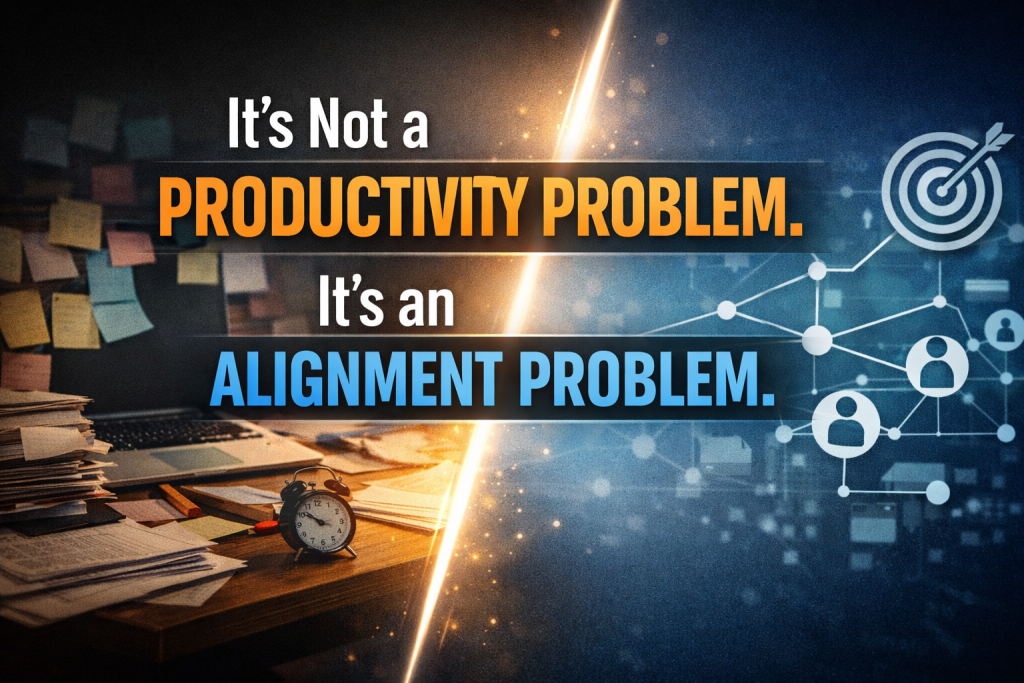
Because what looks like a communication problem, a productivity issue, or even disengagement is often something deeper:
Operational Misalignment
I recently worked with a team that was experiencing what leadership described as “low productivity.” Deadlines were being missed, meetings were increasing, and frustration was building across departments.
On the surface, it appeared to be a performance issue.
But a deeper assessment revealed something else entirely:
- Teams were operating with different interpretations of organizational priorities
- Work was being duplicated across functions without visibility
- Decision-making authority was unclear, causing delays and bottlenecks
The issue wasn’t effort.
It was direction.
This is the hidden cost of misalignment. It doesn’t always present itself clearly. Instead, it shows up disguised as other business problems—slowing execution, creating friction, and draining resources.
So how do organizations begin to address it?
Operational alignment doesn’t happen by accident. It requires intentional design.
First, clarity must come before execution. If teams cannot clearly articulate what matters most, they will default to activity instead of impact.
Second, communication must go beyond information sharing. True alignment requires shared understanding, not just frequent updates.
Third, organizations must actively break down silos. Misalignment often exists in the gaps between teams—particularly during handoffs and cross-functional work.
Fourth, leaders must cultivate ownership, not just accountability. Accountability tracks outcomes, but ownership drives commitment and alignment to purpose.
Fifth, feedback must be continuous and embedded into the system. Waiting for formal review cycles delays necessary course correction.
Finally, organizations must measure more than outcomes. Metrics should also capture clarity, coordination, and consistency—key drivers of aligned execution.
In a complex and fast-moving environment, alignment is no longer a “nice to have.” It is a strategic necessity.
Because ultimately, the difference between struggling teams and high-performing organizations is not effort.
It’s alignment.
The question for leaders is not whether challenges exist.
It’s whether they are solving the right problem.